







Climate and Energy Fund
The fund in broad terms
The Climate and Energy Fund is the government’s key financing instrument for the energy transition. The policy plans for the fund are set out annually in the Multi-Year Programme (Meerjarenprogramma or MJP). In the MJP, the fund’s budget is distributed across six categories:
- Nuclear energy;
- CO₂-free power stations;
- Energy infrastructure;
- Early-stage upscaling;
- Making industry more sustainable and innovation in SMEs; and
- Making the built environment more sustainable.
The allocations in the MJP are formally approved with the Climate and Energy Fund Budget. On Budget Day 2026, the final MJP 2027 and the Climate and Energy Fund Budget 2027 were presented to the House of Representatives for final approval.
When the Climate and Energy Fund was launched in 2021, the total budget amounted to € 35 billion. Prior to execution of the MJP 2027, the remaining balance in the Climate and Energy Fund Budget 2026 was € 21.2 billion.
Budget Day 2026: budget reallocations and revised priorities
Following execution of the MJP 2027, the remaining fund balance stands at € 19.4 billion. Below is an overview of the allocated, reserved and still available funds from the Climate and Energy Fund.
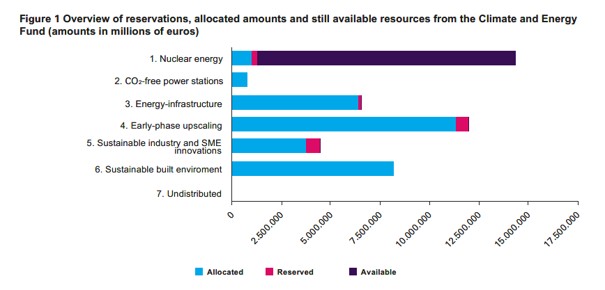
Of the remaining funds, € 6.2 billion has been conditionally allocated to or set aside for specific measures. Of the € 13.2 billion that is still available, € 13.0 billion falls under the ‘Nuclear Energy’ category and € 0.2 billion under the remaining categories. The focus on nuclear energy is clearly evident in this allocation.
The breakdown of the total fund budget following the execution of the MJP 2027 is as follows:
| Category | Fund budget |
|---|---|
| Nuclear Energy | € 13.3 billion |
| CO₂-free power stations | No allocation |
| Energy infrastructure | € 1.0 billion |
| Early-stage upscaling | € 2.7 billion |
| Making industry more sustainable and SME innovation | € 2.4 billion |
| Making the built environment more sustainable | € 25.4 million |
With this allocation, the government aims to achieve higher economic growth and stimulate supply and demand for clean energy. Tackling grid congestion is also crucial in this regard. From the allocated and reserved funds, € 33 million will be available in 2027 for the subsidy scheme for flexible energy use (Flex-e), € 37.7 million for more efficient use of electricity grids and € 3.5 million for the energy infrastructure expert pool.
Offshore wind
From unsubsidised to subsidised tenders in 2026
Offshore wind energy plays a central role in the future of the Dutch energy system. With the current Offshore Wind Energy Roadmap, the government aims to increase available offshore wind capacity to 23 GW by around 2030. The coalition agreement aims for a total of 40 GW by 2040. This would require a capacity increase of approximately 35.3 GW compared to the approximately 4.7 GW currently available.
However, the execution of these plans has faced some setbacks. For instance, the tender for the subsidy-free licensing round for the 1 GW Nederwiek I-A plot in 2025 failed to attract any bids. In response, the government presented the Offshore Wind Energy Action Plan last year, on Budget Day 2025, to stimulate and accelerate the construction of wind farms in the North Sea. Pursuant to this action plan, approximately € 1 billion in subsidies is available in 2026 for the realisation of 2 GW of new offshore wind capacity.
On 16 January 2026, the Minister for Climate and Green Growth briefed the House of Representatives on the forthcoming tender. Instead of the Nederwiek offshore wind energy area, it has been decided to grant a licence for the 1 GW IJmuiden Ver Gamma-A plot with a subsidy. The Government is also presenting an updated Development Framework for offshore wind energy. The grant of subsidies is based on the Temporary Support Mechanism for Offshore Wind Energy. This mechanism is comparable to the SDE++ subsidy scheme and serves as a transitional arrangement until the Contracts for Difference model comes into force, as explained in more detail below.
To increase the tender’s chances of success, the Minister for Climate and Green Growth announced on 11 June 2026 an increase in the subsidy ceiling. The maximum tender amount for IJmuiden Ver Gamma-A has been raised from € 104/MWh to € 117/MWh. The government has also decided to launch a second 1 GW tender in 2026 for the adjacent 1 GW IJmuiden Ver Gamma-B plot. This brings the total capacity to be realised to the 2 GW targeted in the action plan. Both tender periods run from 26 November 2026 to 10 December 2026. The total budgetary allocation for both tenders amounts to approximately € 6.21 billion.
From subsidised tenders to Contracts for Difference (CfD) in 2027
Under the Electricity Market Design Directive, EU Member States wishing to provide direct price support for investments in renewable energy must transition from subsidies to a Contracts for Difference (CfD) based model. Under the CfD-model, the government enters into a two-way contract with the project developer based on a fixed reference price. The model thus offers greater financial certainty for new projects. The transition to the CfD-model must be completed by 17 July 2027 at the latest.
The Offshore Wind Energy Action Plan is paving the way for the transition from subsidised tenders to the CfD-model. The first round of CfDs is expected to open in the autumn of 2027.
The transition from subsidised licensing rounds to a CfD-model also requires a new legal framework. The Government is currently working on a proposal for the Act on the Application of Two-Way Contracts for the Settlement of Differences in Climate and Energy, which would enable the CfD-model to be applied to offshore wind energy, onshore wind energy and solar panels. The bill and the explanatory memorandum have already been submitted to the House of Representatives. Written questions and comments on the bill must be submitted by parliamentary groups by 1 October 2026 at the latest.
Budget Day 2026: subsidised tenders, CfD tenders and long-term strategy
The Ministry of Climate and Green Growth Budget 2027 confirms the target of a total offshore wind energy capacity of 40 GW. An updated, three-part Offshore Wind Energy Roadmap will be published at the end of 2026, setting out the successive expansions to 23, 30 and 40 GW of capacity.
In total, approximately € 360 million will be made available up to and including 2031 for the energy infrastructure of newly designated offshore wind energy areas. In this context, the Draft VAWOZ Programme (Offshore Wind Landfall Connections) is also worth mentioning. This programme was published on 22 May 2026 and explores possible routes for bringing the new capacity generated by (yet-to-be-built) wind farms ashore.
As regards specific measures for the coming year, the commitment budget for the IJmuiden Ver Gamma-A and Gamma-B tenders for 2027 will be increased by € 1.56 billion, so that market participants can factor in the risk associated with the feed-in tariff. The expected cash outflows are based on the multi-year forecast for electricity prices. The transition to the CfD-model is also taken into account, by making available funds for the first two CfD tenders in 2027 and 2028, respectively.
In addition, the Ministry of Economic Affairs and Climate Policy has granted TenneT a subsidy of € 4 billion, of which € 181 million is paid out annually for the construction of the offshore grid. The aim of this grant is to mitigate grid costs for end users. The Budget Memorandum (Miljoenennota) states that the Dutch government will invest approximately € 5.9 billion in offshore wind energy between 2026 and 2035. A total budget of € 60 billion is available to support the expansion to 40 GW of offshore wind energy.
Hydrogen
Development of the national hydrogen infrastructure
Through the National Hydrogen Programme, the government aims to achieve an electrolysis capacity of 3–4 GW by 2035. The key challenge for the government regarding the Dutch hydrogen market is that the necessary infrastructure is still largely lacking. The government aims to stimulate a breakthrough in the hydrogen market by providing funding for the construction of a national hydrogen network and by stimulating demand for hydrogen production.
The construction of the national hydrogen network is carried out by HyNetwork Services, a subsidiary of Gasunie, the state-owned gas network operator. The estimated cost of the hydrogen network was initially put at € 1.5 billion and is being partly financed by the Climate and Energy Fund. In 2023, a subsidy of € 745.8 million was committed to Gasunie the realisation of the national hydrogen network during the period 2023–2030. In addition, approximately € 165 million has been set aside for the realisation of Hystock, the first underground hydrogen storage facility in the Netherlands.
In 2025, the Netherlands Court of Audit warned that the estimated costs of the network had risen to € 3.8 billion, meaning the allocated subsidies would be insufficient. As a result, it remained uncertain whether all the planned routes could be constructed.
Budget Day 2026: development of the national hydrogen network and stimulation of the hydrogen market
The budget documents show that the development of the hydrogen network is continuing and that the allocated subsidies are being utilised. The Ministry of Climate and Green Growth Budget 2027 indicates that the estimated cash payments for the realisation of the hydrogen network in 2027 will amount to approximately € 155 million. In 2028, this is expected to be € 394 million.
In July 2026, the government took a significant step towards hydrogen storage by issuing a subsidy decision, allocating € 450 million to Gasunie for the Hystock project. The subsidy is intended to fund the construction of four underground salt caverns in Zuidwending. The subsidy covers risks that Gasunie cannot bear on its own, including price fluctuations for the required buffer gas, the risk of the caverns not being filled to capacity, and potential delays in the granting of permits. Funding is expected to commence from 2032. Hystock has been designated by the government as a service of General Economic Interest (DAEB) and will continue to secure the necessary licences and permits in 2027.
The Climate and Energy Fund Budget 2027 shows that € 245 million has been set aside for the development of hydrogen caverns 5 to 13 in Zuidwending East. Before the amount is finalised, a due diligence review must be carried out by an independent party. The commitment to spend these funds will only be finalised once a decision has been taken on the financial framework for the hydrogen transport network. If that decision-making process concludes that it is not yet appropriate to commence development of the storage caverns, the funds will be returned to the Climate and Energy Fund.
The budget documents also show that the government intends to invest heavily in the production side via the Climate and Energy Fund. The main allocations are as follows:
- A conditional allocation of € 1,278.3 million for production subsidies for onshore electrolysis (500–1,000 MW);
- A conditional allocation for electrolysis demand subsidies of € 662.2 million; and
- An allocation of € 25 million for the offshore hydrogen research programme.
The budget documents show that the government intends to further develop the hydrogen market, but that much of the support is currently still conditional. Through a combination of standards, pricing and subsidies, the government aims to help achieve the targeted electrolysis capacity of 3–4 GW by 2035.
In this context, a number of relevant legislative developments are also planned. The bill to implement the EU decarbonisation package will be tabled in the House of Representatives this autumn and is intended to regulate the market framework for hydrogen, with a target date of entry into force on 1 July 2027. The draft bill on the annual obligation for renewable fuels of non-biological origin in industry may also contribute to stimulating the hydrogen market. The annual obligation to use these renewable fuels – including renewable hydrogen – would thus rise from 4 per cent in 2030 to 9.9 per cent in 2035. These measures are intended to provide market participants with greater certainty regarding the regulatory framework and future demand for renewable hydrogen.
Carbon capture and storage (CCS)
CCS storage in the North Sea
The government is investing in CCS storage sites in the North Sea through the state-owned company EBN. For example, EBN is participating in the Porthos project in the Port of Rotterdam, for which a loan was granted to EBN in 2020. Subsequently, in December 2023, a loan was granted to EBN for the FEED phase of a second large-scale storage site, the Aramis project. However, due to market uncertainty, demand for CO₂ capture declined, meaning that a Final Investment Decision (FID) could not yet be taken for the Aramis project.
Budget Day 2026: a significant boost for Aramis and CCS infrastructure
From 2027, the government will set aside a maximum of € 1.3 billion for a capacity guarantee covering the transport section of the Aramis CCS chain. The capacity guarantee mitigates the risk that the transport infrastructure will be underutilised in the early years and is thus intended to help create the conditions required to facilitate a positive FID.
In addition, € 639.2 million has been conditionally allocated from the Climate and Energy Fund for EBN’s participation in the development of CCS infrastructure. Alongside Aramis, the government is also supporting broader CCS developments. The Delta Rhine Corridor (DRC) plays a central role in cross-border CO₂ transport. Furthermore, approximately € 15.7 million is earmarked for feasibility and FEED studies and CC(U)S pilots in 2027. The total CCS subsidy budget is set to rise sharply: from approximately € 2.7 million in 2026 to approximately € 334 million in 2028.
Houthoff Energy & Industry team
The Energy & Industry team closely monitors developments within the energy sector and advises on the legal implications of new legislation, regulations and support schemes.
Interested in the Tax Plan 2027 published on Budget Day? Read the Budget Day Special Tax Plan 2027.